
The way I build software has fundamentally changed. For decades, I operated in a system defined by timelines, sprint cycles, coordination overhead, and constant follow-ups. Progress depended not just on skill, but on alignment across people, tools, and processes.
Today, that model feels outdated.
I no longer wait on updates or chase dependencies, no longer lose velocity to communication gaps. I work with AI agents that execute, iterate, and deliver—fast.
- No unnecessary layers.
- No delays.
- No room for human error in repetitive workflows.
For two decades, I’ve combined leadership and innovation to create cutting-edge solutions and guide organizations through transformative change. And this coding agent evolution is not just a productivity upgrade. It is a complete shift in how software gets built.
The Old Way: Managing Work
Traditional software development relies on structured collaboration:
- Product managers define requirements
- Engineers implement features
- QA validates outputs
- DevOps manages deployments
This system works—but it comes with friction:
- Coordination overhead
- Every task requires alignment across multiple roles.
- Time delays
- Even simple changes move through queues, reviews, and approvals.
- Context switching
- Engineers spend significant time moving between tools, tasks, and conversations.
- Human bottlenecks
- Progress slows down when key individuals are unavailable.
Even in high-performing teams, these constraints limit speed. I experienced this firsthand while building scalable systems over the past two decade. Despite strong teams and efficient processes, delivery still depended on orchestration across humans.
That constraint no longer exists in the same way.
The Shift: From Writing Code to Directing Outcomes
Today, I don’t just write code: I define intent.
AI agents take that intent and translate it into execution. Instead of manually implementing every detail, I:
- Describe the problem
- Define constraints
- Set expectations for output
Then the agents:
- Generate code
- Refactor logic
- Run iterations
- Fix errors
- Optimize performance
This is not autocomplete. This is autonomous execution within defined boundaries. The role of the developer has shifted from executor to orchestrator.
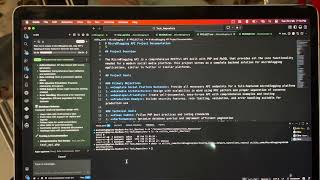
What AI Agents Actually Do
AI agents are not just smarter assistants. They act as execution units that can operate across the software lifecycle.
Here’s how I use them in real workflows.
1. Code Generation and Refactoring
I start with a high-level prompt: “Build a scalable REST API for user authentication with JWT, rate limiting, and logging.”
The agent:
- Structures the project
- Writes modular code
- Adds middleware
- Implements authentication flows
- Suggests improvements
It doesn’t stop at the first output. It iterates until the system works as expected and share detailed plan of execution one you act on implementation it does everything for you.
2. Debugging and Issue Resolution
Instead of manually tracing bugs, I feed logs and context into the agent and it.
- Identifies root causes
- Suggests fixes
- Applies patches
- Validates outcomes
This reduces debugging time from hours to minutes.
3. Testing and Validation
Agents generate:
- Unit tests
- Integration tests
- Edge case scenarios
They simulate failure conditions and refine the system proactively.
4. Documentation and Knowledge Capture
Every system needs documentation, but it often gets neglected.
Agents:
- Generate API documentation
- Write usage guides
- Maintain changelogs
This ensures knowledge remains structured and accessible.
5. Continuous Iteration
The biggest advantage is iteration speed.
I can say:
- “Optimize this function for performance.”
- “Reduce memory usage.”
- “Make this scalable for 1 million users.”
The coding agent adapts instantly.
The Real Impact: Speed, Clarity, and Focus
This shift changes more than just how code gets written. It transforms how decisions are made.
- Speed Without Chaos
Traditional acceleration often leads to technical debt. AI agents, when guided correctly, maintain structure while increasing speed. - Clarity of Thought
When execution becomes fast, thinking becomes the bottleneck. This forces better:- Problem definition
- System design
- Architectural decisions
- Focus on What Matters
Repetitive work disappears. Human effort moves to:- Strategy
- Innovation
- Complex problem-solving
This is where real value lies.
Eliminating Friction, Not People
There is a common misconception that AI replaces developers. That framing is incomplete however a bit true. AI eliminates friction, not thinking. It removes:
- Repetitive coding
- Manual debugging
- Boilerplate generation
- Process overhead
But it amplifies:
- Creativity
- System design
- Decision-making
The best engineers don’t get replaced. They become exponentially more effective.
From Teams to Systems of Intelligence
The structure of building software is evolving. Previously, scaling meant:
- Hiring more engineers
- Adding more coordination layers
- Increasing process complexity
Now, scaling looks different. A single engineer, working with AI agents, can:
- Build faster
- Iterate continuously
- Deliver production-grade systems
This does not eliminate teams, but it changes their composition. Smaller teams can achieve what once required large organizations. The leverage has shifted.
My Workflow Today
My development workflow now looks fundamentally different:
- Step 1: Define the problem clearly
Precision in input leads to quality output. - Step 2: Orchestrate AI agents
Assign tasks across generation, testing, and optimization. - Step 3: Review and refine
Focus on architecture and long-term scalability. - Step 4: Iterate rapidly
Run multiple cycles in minutes instead of days. - Step 5: Ship with confidence
Validated systems reach production faster.
This workflow prioritizes thinking over typing.
The New Skillset for Developers
To thrive in this model, developers need to evolve. Key skills now include:
- Prompt Engineering
Clear instructions drive better outcomes. - System Design Thinking
Understanding architecture becomes more important than syntax. - Critical Evaluation
AI outputs require validation and refinement. - Tool Orchestration
Knowing how to combine multiple agents and workflows creates leverage.
This is a shift from coding skills to thinking systems.
The Risks You Cannot Ignore
This transformation is powerful, but it is not without risks.
- Over-Reliance on AI
Blind trust can introduce hidden issues. - Security Concerns
Generated code must be reviewed for vulnerabilities. - Lack of Deep Understanding
Engineers must still understand what they build.
AI accelerates execution, but responsibility remains human.
The Bigger Shift: From Managing Work to Orchestrating Intelligence
This is the most important change. We are moving from:
Managing tasks and people
to
Orchestrating intelligent systems
The difference is fundamental. Management focuses on coordination. Orchestration focuses on outcomes. AI agents execute, but humans define direction.
Why There Is No Going Back
Once you experience this model, traditional workflows feel slow. Not because people are inefficient, but because the system itself introduces delays.
With AI agents:
- Ideas turn into prototypes instantly
- Feedback loops shrink dramatically
- Execution becomes continuous
The gap between thinking and building disappears. That changes everything.
My Tech Advice: We are at the beginning of a new era in software development. AI agents are not a future concept. They are a present reality.
The question is no longer: “Will AI change how we build?”
The question is: “How fast can you adapt to this shift?”Because the advantage is no longer incremental. It is exponential. It’s not about replacing people. It’s about eliminating friction. And when friction disappears, innovation accelerates.
Ready to build your own tech solution ? Try the above tech concept, or contact me for a tech advice!
#AskDushyant
Note: The names and information mentioned are based on my personal experience; however, they do not represent any formal statement.
#TechConcept #TechAdvice #AI #FutureOfWork #Productivity #Innovation #SoftwareDevelopment #Coding #AIAgent #ProgrammingLanguage #Architecture #SystemDesign


Leave a Reply